Brisbane’s $44 billion infrastructure wave is reshaping the city ahead of 2032
Brisbane is in the middle of the biggest building boom in its history, and most of it has nothing to do with sport. Council figures put the greater Brisbane major projects pipeline at $100.6 billion, with $44 billion of that earmarked for civil and transport infrastructure alone. For a city that used to measure its growth in single suburbs, that’s a different scale of ambition entirely.
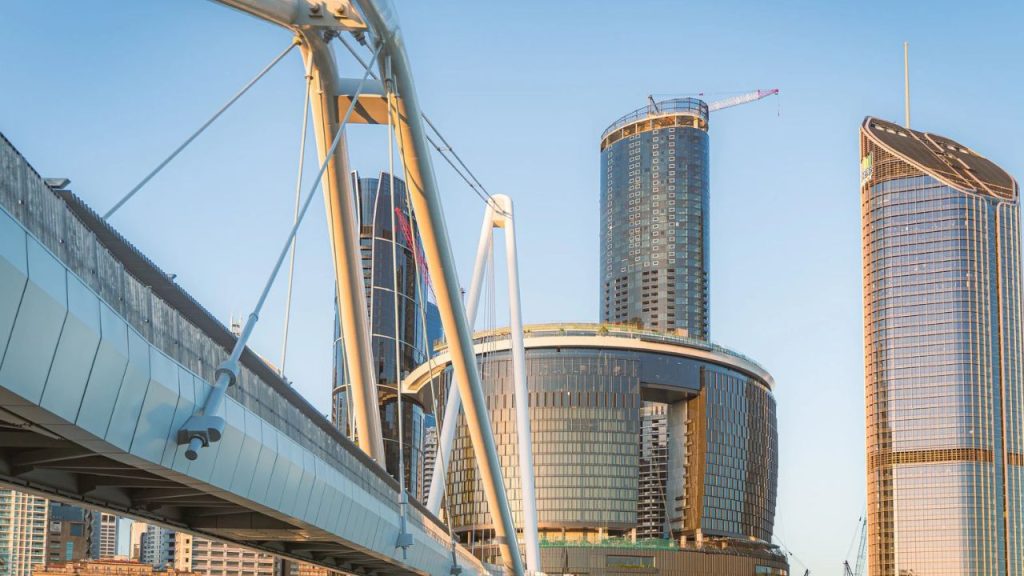
The 2032 Olympic and Paralympic Games get credit for kicking things off, but the money is going well past the venues. Brisbane Metro, which launched in 2025, is already carrying an extra 30 million bus rapid transit trips a year along the city’s busiest corridors. The Beams Road overpass, a $235 million project in the rapidly growing northern suburbs, is due for completion by the end of this year and should take a real bite out of peak hour congestion for commuters who’ve been stuck at that intersection for years. Waterfront Brisbane, a $2.5 billion development bringing 130,000 square metres of office and hospitality space to the city centre, is reshaping the skyline along the river.
Lord Mayor Adrian Schrinner has been blunt about the scale of what’s underway. “Brisbane is not building for 2032,” he said when Council unveiled its countdown clock and legacy vision earlier this year, six years out from the Games opening ceremony. Most host cities wait until twelve months before the Games to mark that kind of milestone. Brisbane did it early, and attached 21 initiatives to it that have more to do with footpaths and local parks than stadiums.
That’s the part locals should pay attention to. Buried in the infrastructure spend is a record road resurfacing program, with Council allocating $79 million to 385 individual resurfacing jobs this year on top of $60 million in corridor upgrades. The Norris Road upgrade and the Chelsea Road and Rickertt Road intersection work have already been delivered. Bridge replacements at Magura Street and Gresham Street are part of a broader push to improve crossing access across the city, much of it tied back to lessons learned from the February 2022 floods. Council has been explicit that flood resilient infrastructure is now a priority, not an afterthought, because nobody wants ratepayers footing a bigger bill the next time the river rises.
Safer School Precincts is another thread running through the budget, with projects progressing in Kedron and several other suburbs aimed at slowing traffic and improving crossings near schools. It’s a smaller line item next to billion dollar transport corridors, but it’s the kind of change that shows up in daily life faster than a new overpass does.
The population numbers explain some of the urgency. Australian Bureau of Statistics data shows Brisbane grew by 72,900 people in the most recent financial year, taking the city to roughly 2.78 million residents. That’s a lot of extra cars, a lot of extra school runs, and a lot of pressure on roads that were designed for a smaller city. Council’s infrastructure charges on new developments are meant to help fund the trunk infrastructure, roads, pathways, parks and stormwater systems needed to keep pace, but the Local Government Infrastructure Plan that coordinates all of it runs on a twenty year horizon. The Games just happen to sit in the middle of that window.
There’s an environmental angle too, and it’s one Council has been keen to highlight alongside the concrete and steel. The city has set a target of 40 percent natural habitat cover by 2031 and is already sitting at 38.9 percent, a number that sounds modest until you consider how much of the city is being dug up for transport works at the same time. Council has framed it as proof that growth and green space don’t have to be a trade-off, though residents in fast developing corridors like the Darling Downs gateway in Brisbane’s outer west might have a different view depending on which side of the fence the next project lands.
Property analysts have taken notice. The McGrath Report 2026 points to the Olympic infrastructure pipeline as one of the main drivers behind Brisbane’s continued property growth, even as affordability starts to bite in the second half of the year. Tenants are currently facing annual increases of 6.2 percent on houses and 6.6 percent on apartments, according to Cotality’s latest figures, and new transport links tend to push values up further in the suburbs they touch. Anyone weighing up a move to the outer north or west might want to track where the next road or rail announcement lands before locking in a suburb.
None of this happens without friction. Big infrastructure spends mean years of lane closures, detours and the kind of dust and noise that comes with any construction site, and Brisbane residents in corridors like Beams Road have been living with that reality for a while now. Council’s bet is that the short term disruption is worth it for a city that connects to 35 international and 62 domestic airports within 25 minutes of the CBD, and that can genuinely claim to be building something that outlasts a seventeen day sporting event.
For residents wanting to track what’s happening in their own area, Council publishes suburb level updates through its Living in Brisbane newsletters, broken down by north, south, east and west, with details on which roads, parks and intersections are next in line. The 2026-27 Budget documents and the Lord Mayor’s budget speech are both available on Council’s website for anyone who wants the full breakdown rather than the headline figures.